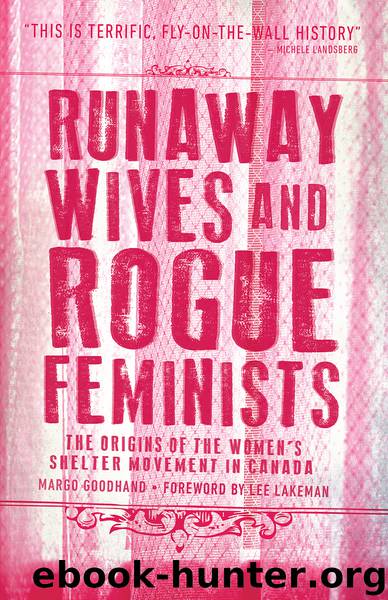
Runaway Wives and Rogue Feminists by Margo Goodhand
Author:Margo Goodhand
Language: eng
Format: epub
Publisher: Fernwood Publishing
Published: 2017-05-06T04:00:00+00:00
CHAPTER 10
VANCOUVER – A HOME BASE AT LAST
B.C.’S NEW HUMAN RESOURCES minister Norm Levi was besieged by women in his first year in office. By all accounts, he didn’t mind much. He was a charming man, English-born, witty and sympathetic to the feminist movement. A trained social worker who had once worked for the John Howard Society in Vancouver, the NDP MLA found himself under pressure from all sides in 1973 — the Y, the Vancouver Status of Women (VSW), community activists, feminists from all corners — to fund a transition house in Vancouver.
He had already been softened up to the cause by the eloquent women of Ishtar, who ambushed him after a speech in Surrey earlier that year to lobby for stable provincial support for their new shelter in the Langley area. Another politician might have become testy or defensive. Levi thought it was funny. But even with Rosemary Brown as his colleague in a left-leaning B.C. legislature, Levi still often expressed the fears of many of that time, from the church to politicians to mainstream media — that by providing a place where women could leave their marriages, feminists would ultimately and inevitably destroy families. No politician could afford to be seen as “anti-family.”
Certainly the young feminists of Ishtar fought this mindset in their conservative community. But so, too, did their older more mainstream counterparts in Edmonton. “The government did not want to give us money,” Beaudry said. “[Some MLAs] plain told us that the women should be at home…. That was an education in itself.”
The conversation often ran along the same lines at public meetings. “We’d say it’s a crime, and the women can’t get out,” explains Gene Errington, Vancouver Status of Woman’s second ombudswoman. “People would ask, ‘Then why doesn’t she leave?’ And we’d say — ‘well, who’s going to help her?’ It was up to us.”
Discouraged by lack of funding and political traction on the issue, many of the Vancouver Women in Transition group had drifted away from the cause by 1973. The VSW was distracted by many other feminist issues, from pay equity to sexual harassment, and only a handful remained focused on the need for a transition house in Vancouver. Errington recalls a few public consultations on the issue, though, including a big meeting at Christchurch Cathedral, where they advocated for the shelter. “There was a lot of media attention,” Errington said. “A lot of the public came. And that’s where this one man stood up and shouted, ‘If we have a house like that in my area, my wife will leave me!’ He was outraged.”
They kept up the pressure. “One thing about those times,” Errington noted, “it was extremely easy to get publicity. There were talk shows all over Vancouver, so we could immediately begin talking about this stuff. There was a climate, at least, where it was being discussed. But we started to get a lot of flak.” The public was “shocked” by what they had to say, Errington remembers, and the reaction was often highly polarized.
Download
This site does not store any files on its server. We only index and link to content provided by other sites. Please contact the content providers to delete copyright contents if any and email us, we'll remove relevant links or contents immediately.
| Africa | Americas |
| Arctic & Antarctica | Asia |
| Australia & Oceania | Europe |
| Middle East | Russia |
| United States | World |
| Ancient Civilizations | Military |
| Historical Study & Educational Resources |
Cecilia; Or, Memoirs of an Heiress — Volume 1 by Fanny Burney(32558)
Cecilia; Or, Memoirs of an Heiress — Volume 2 by Fanny Burney(31956)
Cecilia; Or, Memoirs of an Heiress — Volume 3 by Fanny Burney(31941)
The Secret History by Donna Tartt(19088)
Sapiens: A Brief History of Humankind by Yuval Noah Harari(14389)
Leonardo da Vinci by Walter Isaacson(13336)
The Radium Girls by Kate Moore(12028)
Sapiens by Yuval Noah Harari(5370)
How Democracies Die by Steven Levitsky & Daniel Ziblatt(5218)
The Wind in My Hair by Masih Alinejad(5095)
Homo Deus: A Brief History of Tomorrow by Yuval Noah Harari(4918)
Endurance: Shackleton's Incredible Voyage by Alfred Lansing(4782)
Man's Search for Meaning by Viktor Frankl(4606)
The Silk Roads by Peter Frankopan(4534)
Millionaire: The Philanderer, Gambler, and Duelist Who Invented Modern Finance by Janet Gleeson(4478)
The Rape of Nanking by Iris Chang(4211)
Joan of Arc by Mary Gordon(4110)
The Motorcycle Diaries by Ernesto Che Guevara(4098)
Stalin by Stephen Kotkin(3965)
